Comprehensive Research Guide to the Vilon Peptide: Epigenetic Bioregulation and Cellular Repair
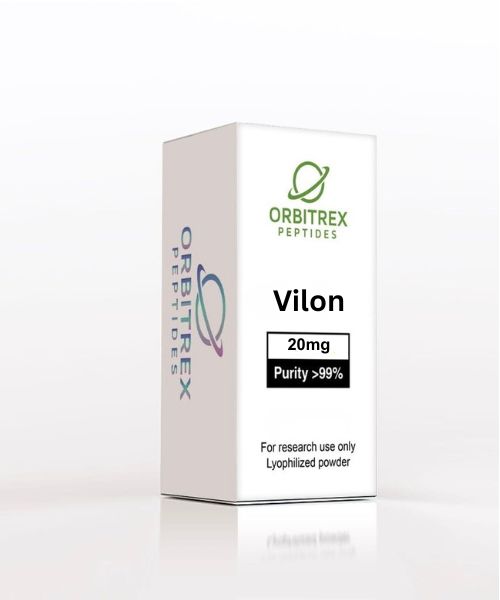
When exploring the absolute cutting edge of gerontology, molecular biology, and advanced cellular rejuvenation, few biochemical compounds offer the profound, systemic importance of the Vilon Peptide. Part of the esteemed “Khavinson Peptides” collection, this specific molecule—a synthetic dipeptide composed of L-Lysine and L-Glutamic acid—is not a traditional growth hormone or steroid. Instead, it is a highly selective epigenetic bioregulator that acts directly on the cell nucleus, fundamentally dictating the rate of tissue regeneration and DNA expression.
This comprehensive guide delves deeply into the biochemical science, structural mechanisms, and rigorous laboratory applications of the Vilon Peptide, providing scientific professionals, longevity researchers, and dedicated biohackers with the critical data required to fully understand its vast physical potential. Whether your focus is investigating the treatment of chronic tissue degradation, studying the profound impact of chromatin decondensation on aging, or exploring novel pathways for immune system modulation, this specific high-purity formulation offers a highly reliable, heavily documented profile for rigorous scientific observation.
The Science of Bioregulation: Why the Vilon Peptide is a Paradigm Shift
To fully grasp the massive efficacy of this critical bioregulator, it is essential to trace the biological role of short peptides in human longevity. For decades, researchers focused on large proteins to influence health. However, the discovery of the Khavinson bioregulators revealed that tiny chains of amino acids—like the Vilon Peptide—possess the unique ability to penetrate the cell membrane and interact directly with DNA.
As we age, our DNA becomes “tightly packed” into heterochromatin, which effectively silences the genes responsible for repair and growth. This leads directly to a massive slowdown in tissue regeneration, a compromised immune system, and the physical manifestations of aging. The Vilon Peptide acts as a biological “key” that unlocks these genes. By inducing chromatin decondensation, the peptide reactivates the protein synthesis required for cellular repair. By artificially reintroducing this massive, high-purity signaling molecule into a biological system, scientists aim to literally restart the body’s internal repair mechanisms, restoring youthful cellular function and forcing aged tissues to rapidly regenerate.
Structural Science: The Simplicity of Lysyl-Glutamic Acid
At its core, the Vilon Peptide is a simple yet elegant dipeptide: L-Lys-L-Glu. Its molecular simplicity is its greatest scientific advantage. Unlike larger, more complex proteins that the body’s immune system might attack or degrade, this tiny sequence is exceptionally stable and possesses an incredible ability to navigate the body’s internal terrain.
In terms of functional biology, the Vilon Peptide works by binding to specific segments of the DNA double helix. This interaction changes the physical structure of the chromatin, making the genetic code more “readable” for the cell’s manufacturing machinery. This process, known as epigenetic regulation, allows the peptide to influence gene expression without changing the underlying DNA sequence. In modern research environments, the specific Vilon Peptide dosage format is highly preferred because it provides an incredibly precise, clinically significant yield for targeted studies in wound healing and immune restoration.
Pharmacokinetics: Absorption, Bioavailability, and Nuclear Targeting
Understanding the complex pharmacokinetic profile of this vital dipeptide is absolutely vital for properly structuring laboratory experiments, determining accurate dosing intervals, and understanding how it achieves its nuclear-level results.
High Bioavailability and Systemic Distribution
One of the most remarkable features of the Vilon Peptide is its robustness. Because it is a dipeptide, it is less susceptible to the rapid enzymatic breakdown that often destroys larger peptide chains. When administered via subcutaneous injection in experimental models, the peptide exhibits incredibly rapid systemic absorption. The unique molecular structure allows the Vilon Peptide to navigate the bloodstream and enter target cells across various organs, from the skin and muscles to the heart and thymus.
Nuclear Penetration and Chromatin Interaction
Once inside the cell, the peptide does not remain in the cytoplasm. It specifically migrates into the nucleus and the nucleolus. Studies indicate that the Vilon Peptide can be detected interacting with nucleolus organizer regions within minutes of administration. This rapid nuclear targeting is what allows for the immediate reactivation of ribosomal genes, leading to a massive spike in the production of the proteins needed for tissue repair.
The Mechanism of Action: How the Vilon Peptide Interacts with the Body
Understanding how this specific, targeted sequence exerts its profound regenerative effects requires a highly detailed dive into epigenetic signaling. Its mechanism of action is distinctly multifaceted, operating seamlessly at the molecular level to force the body into an optimized state of healing.
1. Deheterochromatinization (Chromatin Unrolling)
The primary, absolutely critical mechanism observed in laboratory models is the unrolling of “silent” DNA. In aged cells, much of the genome is locked away in a condensed state. The Vilon Peptide induces a physical change in these regions, making the genes accessible once again. This massive reactivation of “repressed” genes is the absolute requirement for reversing cellular senescence and restoring the regenerative capacity of aged tissues.
2. Potent Immunomodulation
Beyond simple tissue repair, this sequence is a powerful regulator of the thymus—the “school” of the immune system. In research settings, the Vilon Peptide has shown the ability to stimulate the proliferation of thymocytes and improve the function of T-cells. This is a massive biological unlock because it helps restore the immune system’s ability to identify and neutralize internal threats (like cancer cells) and external pathogens, making it a primary subject of interest for geroprotective research.
3. Synergistic Tissue Regeneration
The compound successfully targets fibroblasts and growth factors. In experimental models, the Vilon Peptide has demonstrated the ability to increase the synthesis of Ki-67 (a marker of cell proliferation) and reduce the expression of caspase-3 (a marker of cell death). This highly nuanced tissue-regulatory effect is exactly why the peptide is aggressively studied for its massive potential to completely eliminate chronic inflammation in the joints, skin, and organs, radically improving the body’s resilience to injury.
Primary Research Applications in the Laboratory
The remarkably diverse, absolutely foundational biological activities of this molecule have led to a rapidly expanding array of high-level research applications. The baseline Vilon Peptide formulation is particularly useful for exploring the following cutting-edge scientific avenues:
Reversing Age-Related Tissue Atrophy
In the realm of gerontology, this sequence is considered a groundbreaking tool for studying the restoration of muscle, skin, and organ mass. Studies frequently focus on its capacity to aggressively stimulate the repair of tissues that have thinned or weakened due to advanced age. Researchers utilize the Vilon Peptide to observe how biochemical interventions can completely neutralize the “wear and tear” of aging without the risks associated with hormone replacement therapy.
Advanced Wound Healing and Surgical Recovery
Physical recovery from trauma or surgery is entirely dictated by how efficiently the body can produce new, healthy cells. Studies involving the Vilon Peptide have deeply explored its unique ability to rapidly “reboot” the healing cascade. By massively increasing the production of fibroblasts and collagen, it is continuously investigated as a critical, highly successful tool for violently accelerating recovery times and physically repairing both external and internal wounds.
Cancer Prevention and Oncomodulation
Because of its ability to restore healthy gene expression and support immune surveillance, the peptide is a subject of intense study in oncology research. Experimental models show that the Vilon Peptide can help the body maintain a healthy “epigenetic landscape,” preventing the mutations and gene silencing that often lead to tumor development. Researchers deeply use the molecule to map how the body’s natural defenses against cancer can be actively supported through improved bioregulation.
The Importance of High-Purity Synthesis in Laboratory Settings
In any rigorous, peer-reviewed scientific study or biohacking protocol, the sheer absolute quality of the primary compound directly dictates the absolute validity of the final results. Utilizing an ultra-high-purity Vilon Peptide synthesis is entirely non-negotiable for serious clinical researchers and dedicated longevity optimizers.
Impurities in standard peptide manufacturing can heavily include unreacted amino acids or chemical byproducts left over from the synthesis process. If a laboratory or individual inadvertently utilizes a compromised, low-grade batch of the Vilon Peptide, these invisible impurities can trigger massive, uncontrolled immune responses or heavily skew quantitative regenerative data, rendering months of incredibly expensive anti-aging research completely invalid.
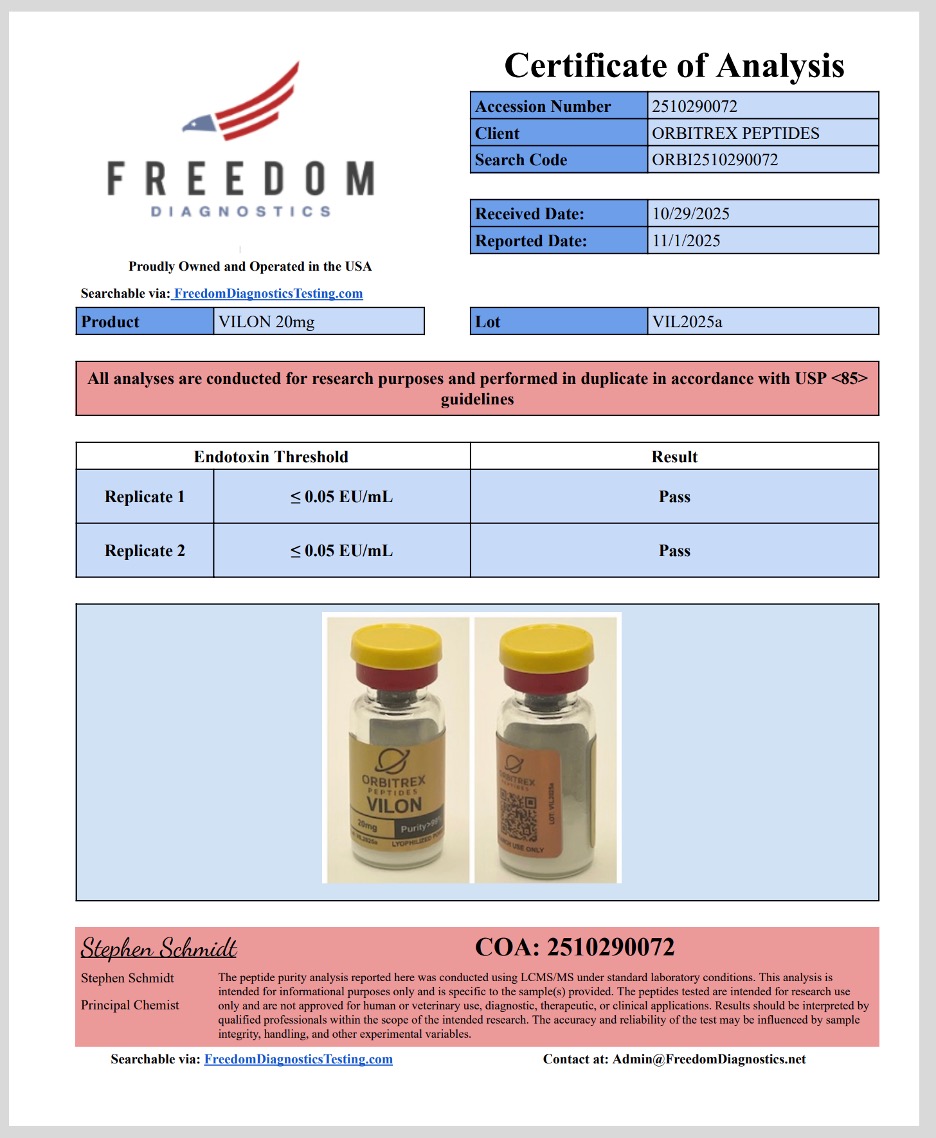
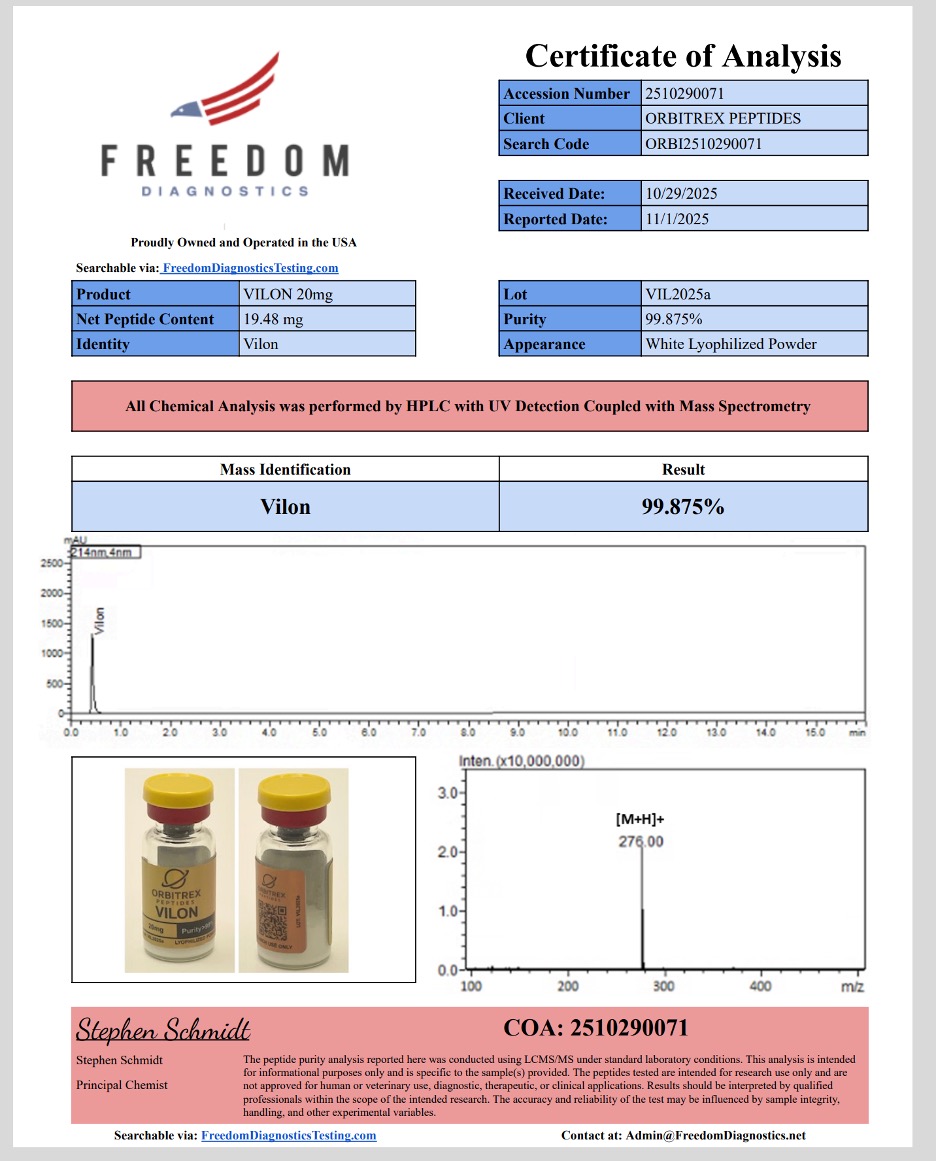
High-grade research compounds must ideally boast an absolute purity of strictly >99%, independently verified by third-party High-Performance Liquid Chromatography (HPLC) and Mass Spectrometry (MS). This rigorous, massive analytical testing guarantees that the biological activity observed during testing is directly, undeniably attributable to the pure, unadulterated Lysyl-Glutamic acid sequence and absolutely nothing else.
Preparation, Reconstitution, and Storage Protocols
Meticulous, proper handling is profoundly, absolutely critical to maintaining the delicate molecular stability of this dipeptide bioregulator. Because the product is securely delivered as a stable, highly sensitive lyophilized powder, researchers must strictly follow clinically sterile protocols for reconstitution and long-term storage.
Standard Reconstitution Protocol
To adequately prepare the highly potent Vilon Peptide vial for clinical application, it must be carefully reconstituted using a sterile solvent, almost universally bacteriostatic water or sterile saline.
-
Allow the sealed vial to organically reach room temperature before opening to completely prevent massive condensation from forming inside the glass.
-
Swab the protective rubber stopper vigorously with a 70% isopropyl alcohol wipe to ensure a completely sterile injection site.
-
Carefully inject the calculated volume of bacteriostatic water, specifically aiming the liquid stream against the inner glass wall.
-
Allow the massive powder puck to dissolve gently and naturally. Do not shake the vial vigorously; instead, roll the glass gently between your fingers until the complex solution is completely clear and beautifully transparent.
Long-Term Storage Guidelines
-
Lyophilized Powder: Before liquid reconstitution, the stable freeze-dried solid can be safely stored at room temperature for several weeks without any significant degradation. For extensive long-term storage (spanning several months to years), Vilon Peptide vials should be strictly kept in a dark laboratory freezer at -20°C to massively preserve indefinite structural integrity.
-
Reconstituted Solution: Once successfully mixed with bacteriostatic water, the molecular structure becomes highly susceptible to rapid degradation from ambient heat and direct UV light exposure. The active liquid solution must be kept consistently refrigerated at 2°C to 8°C (36°F to 46°F) and should generally be completely utilized within 20 to 30 days to ensure maximum biological efficacy and complete, absolute sterility.
Frequently Asked Questions About Vilon Research
How does this differ from Epitalon? While both are Khavinson bioregulators, the Vilon Peptide and Epitalon target different systems. Epitalon is a pineal gland regulator primarily researched for telomere lengthening and circadian rhythm regulation. Vilon, however, is a thymic regulator focused on immune function and rapid tissue regeneration. In advanced longevity protocols, they are often researched together for their massive, systemic anti-aging synergy.
Can it be used for joint and ligament repair? The highly potent Vilon Peptide is extensively researched for its role in stimulating fibroblasts—the cells responsible for building connective tissue. By increasing the expression of genes involved in collagen and elastin production, the peptide is a primary subject of interest for researchers looking to reverse the degradation associated with osteoarthritis and chronic joint injuries.
Is the peptide structurally stable during standard international transit? Yes, in its lyophilized, freeze-dried form, the dipeptide is remarkably chemically robust. The advanced freeze-drying process completely removes the moisture that traditionally facilitates rapid molecular degradation. While it is always best practice to immediately store the Vilon Peptide in a cool, absolutely dark environment upon arrival, standard transit times at ambient temperatures do not heavily compromise the strict integrity of the powder.
Conclusion: The Absolute Future of Epigenetic Medicine
The ongoing, massive global exploration of peptide bioregulators represents the absolute cutting edge of modern biology and severe anti-aging medicine, and the Vilon Peptide remains at the very forefront of this massive biochemical scientific revolution. From its profound, heavily documented ability to perfectly regulate gene expression through chromatin unrolling to its incredible immune-regulatory and tissue-repair capabilities, it offers clinical researchers a highly reliable, incredibly potent, and endlessly fascinating compound for biochemical study.
By ensuring your laboratory sources an ultra-high-purity product and adheres strictly to rigorous, sterile handling protocols, you can confidently explore the vast, absolutely untapped potential of this remarkable sequence. As advanced molecular research methodologies violently evolve and biological mapping technology improves, the massive empirical data generated from Vilon Peptide studies will undoubtedly continue to heavily unlock profound new understandings of the epigenome, absolute cellular repair, and ultimate human longevity.
(Disclaimer: All information provided regarding this product is strictly for educational and informational purposes. This product is sold exclusively for laboratory and research use. It is not intended for human consumption, diagnosis, treatment, or cure of any disease or condition.)