
Buy Semax 30mg Peptide: The Advanced Neurogenic Heptapeptide
Elevating Neurobiological Research with the Semax 30mg Peptide
As the global scientific community continues to meticulously map the profound complexities of the central nervous system, synaptic plasticity, and the precise, epigenetic regulation of neuronal survival during extreme biological stress, the demand for highly targeted, structurally stable molecular tools has exponentially increased. Enter the Semax 30mg Peptide, an industry-leading synthetic analogue designed specifically to support rigorous, high-level in-vitro laboratory analysis, targeted neuronal cell modeling, and precision neuro-epigenetic screening.
This highly stable, lyophilized powder represents a foundational, highly fascinating achievement in targeted neuro-biochemistry. While much of the past century’s neurological research focused heavily on broad-spectrum neurotransmitter analogues or highly toxic excitatory agents, the Semax 30mg Peptide allows independent researchers and advanced testing facilities to study the profound baseline regulation of the neuronal survival matrix itself. By acting as a highly specific, degradation-resistant melanocortin and neurotrophic analogue, it enables laboratories to observe the natural transcription, synthesis, and repair mechanisms of neuronal networks without inducing the destructive neurotoxicity associated with chronic cellular overstimulation.
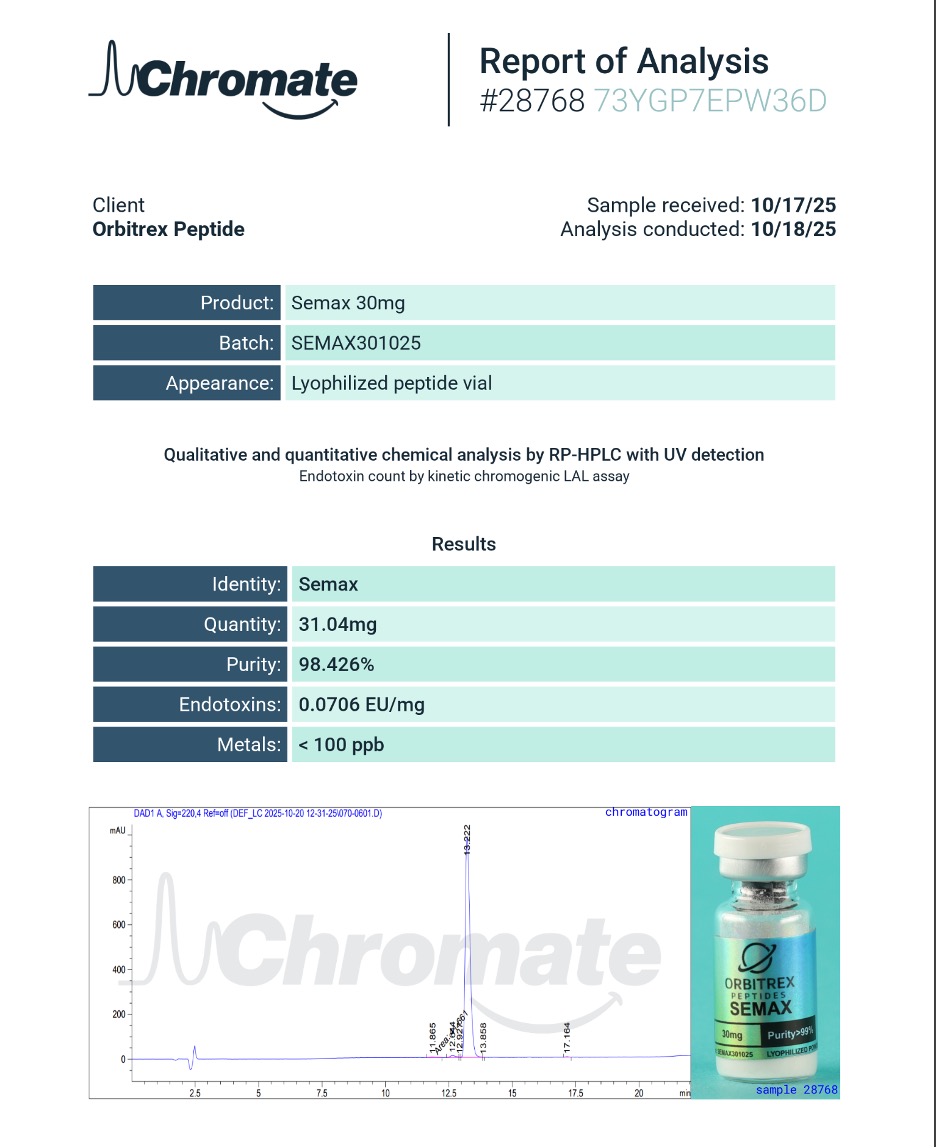
What truly sets this specific listing apart for the advanced laboratory is its classification as an industrial-scale, high-capacity master unit. By providing a massive, specifically measured 30mg dosage in a sterile, vacuum-sealed glass vial, the Semax 30mg Peptide offers the perfect, standardized material for laboratories conducting high-throughput neurotoxicity screening, extended multi-well cellular assays, and incredibly precise dose-escalation curves. This 30mg yield allows researchers to rigorously test complex cytoprotective and synaptogenic hypotheses on specialized cell lines across hundreds of simultaneous cultures. Creating a single, massive master-batch from this vial ensures highly efficient use of expensive laboratory resources, minimizes chemical waste, and entirely eliminates the devastating risk of batch-to-batch molecular variation that typically plagues longitudinal neurological experiments.
The Biochemical Engineering of the Semax 30mg Peptide
To truly understand the profound analytical and research value of the Semax 30mg Peptide, scientists must first deeply examine its brilliant, highly specialized structural engineering. The molecule is fundamentally a synthetic heptapeptide, meaning it is a tightly bound, seven-amino-acid chain.
Specifically, the sequence is Methionyl-Glutamyl-Histidyl-Phenylalanyl-Prolyl-Glycyl-Proline (Met-Glu-His-Phe-Pro-Gly-Pro).
In natural biological systems, the anterior pituitary gland produces Adrenocorticotropic Hormone (ACTH), a massive polypeptide heavily involved in the body’s response to biological stress. Biochemists discovered that a very specific, tiny fragment of this massive ACTH molecule—specifically the amino acids at positions 4 through 7 (Met-Glu-His-Phe)—possessed remarkable neuro-stimulating properties entirely separate from the hormone’s primary stress-inducing functions.
However, utilizing the isolated ACTH(4-7) fragment in a laboratory setting proved incredibly difficult. Native, short-chain neuropeptides are notoriously unstable in in-vitro environments. When introduced to a cellular medium, they possess an extremely short half-life (often just seconds to minutes) due to rapid, aggressive enzymatic degradation by highly active proteases and peptidases present within the cellular fluid.
The Semax 30mg Peptide circumvents this biological limitation through highly advanced synthetic molecular engineering. To protect the highly active ACTH(4-7) core, biochemists securely attached a synthetic tripeptide tail to the C-terminus of the molecule: the Pro-Gly-Pro (PGP) sequence.
This specific C-terminal modification is a biochemical masterstroke. In an in-vitro cell culture environment, the Pro-Gly-Pro tail acts as an impenetrable molecular shield. It creates massive steric hindrance, effectively rendering the active neuro-fragment completely invisible and highly resistant to the destructive cleavage of endogenous peptidases, preserving the absolute integrity of the heptapeptide chain. This drastically extends its functional half-life, providing researchers with an incredibly stable, sustained neuro-receptor activation that native hormones and unprotected fragments simply cannot achieve in a controlled petri dish environment.