Buy Cagrilintide 10mg Peptide: Advanced Amylin Analog
Elevating Metabolic Research with the Cagrilintide 10mg Peptide
As the scientific community’s understanding of cellular metabolism, energy homeostasis, and endocrine signaling expands, laboratories require highly specific, long-acting molecular tools to map complex receptor pathways. Enter the Cagrilintide 10mg Peptide, a breakthrough synthetic compound designed for rigorous, high-level in-vitro laboratory analysis.
This highly stable, lyophilized powder represents the cutting edge of Dual Amylin and Calcitonin Receptor Agonists (DACRAs). While much of the recent decade’s metabolic research has focused heavily on Glucagon-Like Peptide-1 (GLP-1) and Gastric Inhibitory Polypeptide (GIP) pathways, the Cagrilintide 10mg Peptide allows independent researchers and testing facilities to pivot their focus toward the heavily nuanced amylin pathways.
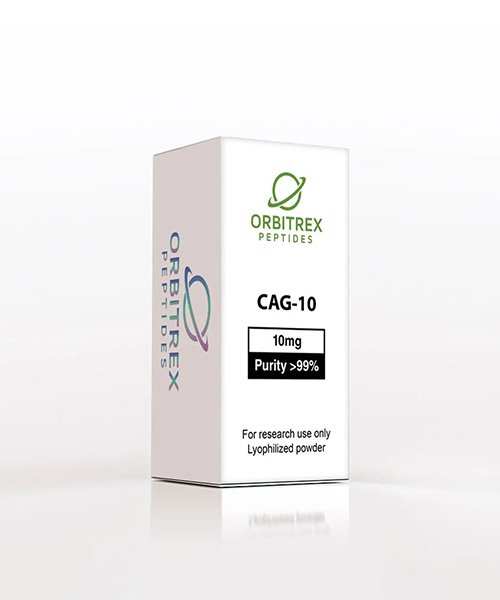
By providing a precise, pre-measured 10mg dosage in a sterile vial, this compound ensures standardized baselines across all of your complex cellular assays, receptor binding experiments, and metabolic modeling. Purchasing this isolated, high-purity amylin analog eliminates the variable of structural degradation often seen in older, short-acting metabolic peptides, providing researchers with an incredibly stable tool for investigating cellular signaling cascades over extended analytical periods.
The Synergistic Science Behind the Cagrilintide 10mg Peptide
To understand the analytical value of the Cagrilintide 10mg Peptide, researchers must first examine the biological role of native amylin. Also known as Islet Amyloid Polypeptide (IAPP), natural amylin is a 37-amino-acid peptide hormone that is co-secreted with insulin from the pancreatic beta cells in a roughly 1:100 ratio.
In natural biological systems, amylin plays a critical role in glycemic regulation by slowing gastric emptying, inhibiting digestive secretions (like gastric acid and pancreatic enzymes), and communicating with the central nervous system to promote profound satiety. However, native human amylin is notoriously unstable in laboratory environments. It is highly prone to rapid fibril formation and aggregation—literally clumping together in a solution—which makes it practically useless for extended in-vitro assays or long-term cell culture exposure.
This is where the Cagrilintide 10mg Peptide represents a massive leap forward in synthetic biology. Cagrilintide is a long-acting, acylated analog of human amylin. Scientists engineered this molecule by making specific amino acid substitutions to prevent the fibril aggregation that plagues native amylin. Furthermore, the peptide chain has been intricately modified through the attachment of a C16 fatty diacid chain (a process known as acylation) via a glutamic acid spacer.
In-vitro, this specific molecular acylation allows the Cagrilintide 10mg Peptide to bind non-covalently to blood albumin, drastically extending its half-life and preventing rapid enzymatic degradation. For the laboratory researcher, this means the compound can be introduced to a cell culture and observed over a period of days—rather than minutes or hours—providing an incredibly stable, sustained receptor activation that older peptides simply cannot match.
Dual Receptor Agonism: Amylin and Calcitonin Pathways
What makes the Cagrilintide 10mg Peptide so unique in the realm of synthetic biology is its nature as a Dual Amylin and Calcitonin Receptor Agonist (DACRA). In cell culture models, the compound does not merely bind to one target; it interacts profoundly with two distinct, yet highly related, receptor families.
1. The Amylin Receptor Pathway: The amylin receptor is not a single, simple structure. It is actually a complex formed by the calcitonin receptor (CTR) combining with one of three Receptor Activity-Modifying Proteins (RAMPs). When researchers introduce the Cagrilintide 10mg Peptide to a cellular assay expressing these RAMPs, it acts as a highly potent, non-selective agonist across all amylin receptor subtypes (AMY1, AMY2, and AMY3). This interaction triggers robust intracellular signaling cascades, primarily through the elevation of cyclic AMP (cAMP) and the mobilization of intracellular calcium ions.
2. The Calcitonin Receptor Pathway: Because the core of the amylin receptor is the calcitonin receptor (CTR), the Cagrilintide 10mg Peptide also exhibits strong agonism directly at the CTR. This presents an incredibly fascinating secondary avenue for laboratory research. The calcitonin receptor is heavily involved in bone metabolism, calcium homeostasis, and the regulation of osteoclast activity (the cells responsible for bone resorption). Consequently, laboratories utilizing this compound can design assays that observe not only metabolic and glycemic responses but also fundamental shifts in osteology and bone-density signaling at the cellular level.
Differentiating Cagrilintide from GLP-1 Analogs
In the modern laboratory, it is crucial to understand how the Cagrilintide 10mg Peptide differs from ubiquitous GLP-1 analogs like Semaglutide, Tirzepatide, or Retatrutide.
While GLP-1 analogs mimic the incretin hormones released by the intestines to stimulate insulin secretion in a glucose-dependent manner, the Cagrilintide 10mg Peptide operates on an entirely different physiological axis. Amylin analogs do not directly stimulate insulin secretion. Instead, they operate as a complementary mechanism. In-vitro, the introduction of an amylin analog alongside a GLP-1 analog allows researchers to observe a profound, non-overlapping synergistic effect on cellular metabolism and energy homeostasis.
This synergistic potential is why the Cagrilintide 10mg Peptide is frequently purchased by advanced testing facilities aiming to replicate the receptor mechanisms of cutting-edge, multi-agonist therapies currently being investigated in the broader scientific community.
Verifiable Science Supporting the Cagrilintide 10mg Peptide
The complex biochemical mechanisms and dual-receptor agonism of amylin analogs are extensively documented in modern peer-reviewed scientific literature. Researchers investigating the fundamental properties of these advanced acylated peptides can find numerous published studies detailing their physiological effects on isolated cell lines and animal models.
For highly authoritative data regarding the exact receptor-binding profiles, structural modifications, and metabolic signaling pathways of long-acting amylin analogs, researchers are highly encouraged to review extensive physiological studies and clinical data via the National Center for Biotechnology Information (NCBI). Accessing this foundational research provides a peer-reviewed, rock-solid baseline for laboratories planning to utilize the Cagrilintide 10mg Peptide in their own novel analytical experiments.
Ideal In-Vitro Applications for the Cagrilintide 10mg Peptide
Because of its unparalleled dual-pathway approach to cellular signaling and its highly stable acylated structure, the Cagrilintide 10mg Peptide is incredibly versatile and can be deployed in a vast variety of complex in-vitro assays. Laboratories purchasing this advanced compound frequently utilize it for the following research models:
-
Receptor Binding Affinity Assays: Utilizing the compound in cell lines expressing precise ratios of calcitonin receptors and RAMPs to measure the exact stoichiometry and binding kinetics of acylated amylin analogs compared to native, non-acylated IAPP.
-
Synergistic Metabolic Modeling: Co-administering the Cagrilintide 10mg Peptide alongside GLP-1 analogs (like Semaglutide) within a single cell culture to track the amplified, non-competing up-regulation of intracellular cAMP and secondary messenger proteins.
-
Osteoclast Inhibition Studies: Applying the compound to bone marrow-derived cell lines to observe the calcitonin-receptor-mediated suppression of osteoclast differentiation and bone resorption, studying its potential impact on skeletal cellular health.
-
Fibril Aggregation and Stability Research: Utilizing the engineered structure of the Cagrilintide 10mg Peptide as a control variable in protein-folding experiments, contrasting its molecular stability against the rapid degradation and amyloid plaque formation typical of native human amylin.
Independent Laboratory Testing and Purity Standards for the Cagrilintide 10mg Peptide
At Orbitrex, we intrinsically understand that your analytical research data is only as accurate, reproducible, and reliable as the raw materials you test. If a complex acylated peptide contains micro-impurities, excess salts, or degraded amino acid chains, it will instantly introduce unpredictable variables into your research, effectively rendering your expensive analytical data completely useless.
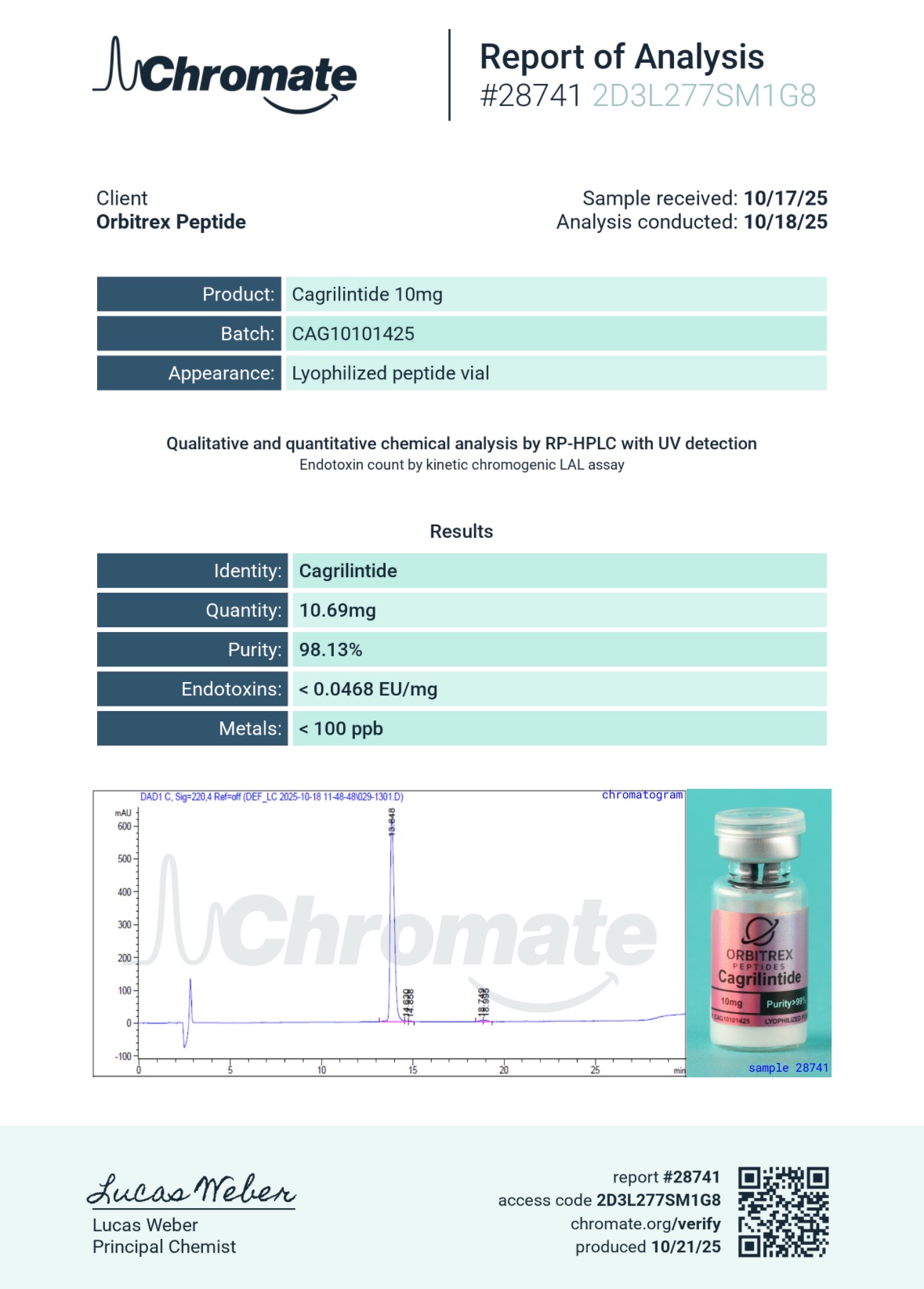
This is precisely why we guarantee that every single batch of our Cagrilintide 10mg Peptide undergoes the most rigorous, independent third-party testing available before it is ever cleared for distribution to the scientific community.
Our primary testing methodologies include High-Performance Liquid Chromatography (HPLC) and Liquid Chromatography-Mass Spectrometry (LC-MS). The HPLC analysis ensures that the molecular weight and retention time of the powder perfectly match the exact profile of pure Cagrilintide, successfully separating out any potential contaminants, leftover solvents, or truncated peptide fragments.
The Mass Spectrometry confirms the exact amino acid sequence of the peptide, as well as the successful attachment of the critical C16 fatty diacid chain. Manufacturing an acylated peptide requires immense biochemical precision; our LC-MS testing guarantees there are no missing or malformed links in the molecular structure.
We mandate strictly >99% purity for the Cagrilintide 10mg Peptide, ensuring your laboratory receives uncompromised materials entirely free from binders, heavy metals, synthetic impurities, or leftover manufacturing byproducts. When you source your complex metabolic materials from Orbitrex, you are sourcing absolute, verifiable reliability.
Preparation and Handling of the Cagrilintide 10mg Peptide
Due to the highly fragile molecular structure of engineered amino acid chains, the proper preparation, reconstitution, and storage of the Cagrilintide 10mg Peptide are absolutely critical to maintaining its analytical efficacy and preventing rapid degradation prior to your planned experiments.
The product is shipped as a lyophilized (freeze-dried) solid powder inside a sterile, vacuum-sealed glass vial. Lyophilization removes the water from the peptide solution under extremely low temperature and pressure, which stabilizes the fragile molecular bonds and allows the Cagrilintide 10mg Peptide to survive the domestic shipping process without rapid degradation or structural collapse.
Reconstitution Protocols
To prepare the Cagrilintide 10mg Peptide for in-vitro application, the powder must be carefully reconstituted into a liquid solution. It is highly recommended to use sterile bacteriostatic water (water containing 0.9% benzyl alcohol) or sterile saline, depending entirely on the specific chemical requirements of your cell culture.
When introducing the diluent into the vial containing the Cagrilintide 10mg Peptide, standard sterile laboratory protocols must be strictly observed:
-
Swab the rubber stopper of both the peptide vial and the diluent vial with 70% isopropyl alcohol.
-
Using a sterile syringe, draw the exact desired volume of diluent.
-
Inject the diluent extremely slowly into the peptide vial. Crucial: Direct the stream of the liquid against the inner glass wall of the vial rather than shooting it directly into the lyophilized powder. The force of a direct, high-pressure liquid stream can physically shear the delicate peptide bonds of the Cagrilintide 10mg Peptide, irreparably damaging the molecules before they are ever utilized.
-
Do not shake the vial. Vigorous shaking will destroy the amino acid sequences and disrupt the acylated structure. Gently swirl or roll the vial between your fingers until the powder has completely dissolved into a clear, uniform solution.
Storage Guidelines for the Cagrilintide 10mg Peptide
Maintaining the molecular integrity of the Cagrilintide 10mg Peptide post-reconstitution is paramount to the success, accuracy, and reproducibility of your research.
Unreconstituted (Lyophilized Powder): If you are not utilizing the peptide immediately upon delivery, the dry powder should be stored away from direct sunlight in a completely dry environment. For short-term storage (up to 30 days), room temperature is acceptable, though refrigeration is preferred. For long-term storage (up to 24 months), the lyophilized vials must be kept in a dedicated laboratory freezer at -20°C.
Reconstituted (Liquid Solution): Once bacteriostatic water or saline has been introduced to the Cagrilintide 10mg Peptide, the structural degradation clock begins ticking immediately. The reconstituted vial must be immediately refrigerated at 2°C to 8°C (36°F to 46°F). Even when kept at precise, temperature-controlled refrigerated settings, the mixed solution must be utilized in your assays within 20 to 30 days. Beyond this tight window, the delicate peptide chains will begin to naturally degrade, losing their biological potency, breaking down into unusable fragments, and inevitably skewing your analytical data.
Disclaimer: All products listed by Orbitrex, including the Cagrilintide 10mg Peptide, are sold strictly for in-vitro laboratory research and analytical purposes only. They are not intended for human consumption, ingestion, diagnostic, therapeutic, or agricultural use. Our products are not FDA-approved for human use. Any communications implying human use, clinical trials on unapproved human subjects, or bodily injection will result in the immediate cancellation of your account and permanent restriction from our supply chain. All researchers must adhere to their local institutional review board (IRB) guidelines when handling these research materials.