Buy Ipamorelin 10mg Peptide: The Advanced Selective Secretagogue
Elevating Endocrine Research with the Ipamorelin 10mg Peptide
As the global scientific community continues to meticulously map the profound complexities of the human endocrine system, cellular metabolic homeostasis, and the precise, receptor-specific regulation of the somatotropic axis, the demand for highly targeted, structurally stable molecular tools has exponentially increased. Enter the Ipamorelin 10mg Peptide, an industry-leading synthetic analogue designed specifically to support rigorous, high-level in-vitro laboratory analysis, targeted pituitary cell modeling, and precision endocrine screening.
This highly stable, lyophilized powder represents a foundational, highly fascinating achievement in targeted neuroendocrine biochemistry. While much of the early research into Growth Hormone Releasing Peptides (GHRPs) utilized older, first-generation compounds (such as GHRP-6 or GHRP-2), those older molecules were notoriously “dirty” in a laboratory setting—meaning they triggered massive, unwanted secondary hormonal cascades. The Ipamorelin 10mg Peptide represents the third generation of these compounds. It allows independent researchers and advanced testing facilities to study the profound, isolated effects of the ghrelin receptor without overriding or corrupting the cellular environment with stress-hormone cross-contamination.
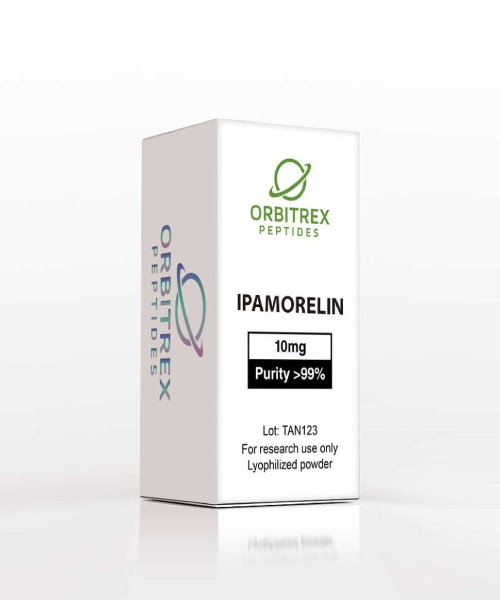
What truly sets this specific listing apart for the advanced laboratory is its highly precise, industry-standard volume. By providing a specifically measured 10mg dosage in a sterile, vacuum-sealed glass vial, the Ipamorelin 10mg Peptide offers the perfect, standardized material for laboratories conducting isolated control experiments, specialized single-run cellular assays, or establishing precise comparative baselines against older GHRP compounds. This 10mg yield allows researchers to rigorously test complex pituitary and osteoblast hypotheses on specialized cell lines without committing to massive industrial volumes, ensuring highly efficient use of laboratory resources, minimizing chemical waste, and maintaining absolute structural purity for localized, individual baseline experiments.
The Biochemical Engineering of the Ipamorelin 10mg Peptide
To truly understand the profound analytical and research value of the Ipamorelin 10mg Peptide, scientists must first deeply examine its brilliant, highly specialized structural engineering. The molecule is fundamentally a synthetic “pentapeptide,” meaning it is an incredibly short, tightly bound chain consisting of exactly five amino acids.
Specifically, the highly engineered sequence is Aib-His-D-2-Nal-D-Phe-Lys-NH2.
In natural biological systems, the stomach produces an endogenous hormone called ghrelin (often referred to as the “hunger hormone”). Ghrelin travels through the bloodstream and binds to specific receptors in the pituitary gland to stimulate a massive release of growth hormone. However, natural ghrelin is a 28-amino-acid peptide that is notoriously unstable in laboratory environments and possesses an extremely short half-life due to rapid enzymatic degradation.
By utilizing advanced synthetic biochemistry, researchers engineered the Ipamorelin 10mg Peptide to mimic the GH-releasing properties of ghrelin, but within a vastly superior, highly stabilized structural framework.
This stabilization is achieved through several masterful molecular modifications. First, the inclusion of Aib (alpha-aminoisobutyric acid) at the extreme N-terminus provides profound steric hindrance, protecting the delicate pentapeptide from being cleaved by standard circulating proteases. Second, the strategic incorporation of D-amino acid isomers (specifically D-2-Naphthylalanine and D-Phenylalanine) fundamentally alters the spatial geometry of the chain. Because natural biological enzymes are designed exclusively to break down L-amino acids, these synthetic D-isomers render the peptide virtually invisible to enzymatic degradation. This ultra-short, highly fortified construction provides researchers with an incredibly precise, highly reactive secretagogue that can be utilized in extended petri-dish assays and multi-day cell culture incubations.
Synergistic Mechanisms: Highly Selective GHSR-1a Agonism
The clinical and analytical value of the Ipamorelin 10mg Peptide as a primary research tool lies entirely in its nature as a highly potent, exceptionally selective agonist of the Growth Hormone Secretagogue Receptor 1a (GHSR-1a). Unlike GHRH analogues (like Sermorelin or CJC-1295) which operate via the cAMP secondary messenger pathway, Ipamorelin operates on an entirely different physiological axis, making it an invaluable tool for comprehensive somatotropic modeling.
When introduced to complex neuroendocrine cell cultures, the Ipamorelin 10mg Peptide exerts its massive biological influence through highly researched, localized physiological pathways.
The GHSR-1a Pathway and Intracellular Calcium Influx
The primary, direct function of the Ipamorelin 10mg Peptide is its aggressive, rapid agonism of the GHSR-1a receptors, which are heavily expressed on the surface of somatotroph cells within the anterior pituitary gland.
When researchers apply this specific pentapeptide to isolated pituitary cell cultures, the binding event triggers a massive, highly orchestrated intracellular signaling cascade. Because the GHSR-1a is a G-protein-coupled receptor linked to the phospholipase C pathway (rather than the adenylate cyclase pathway), the cellular response is mechanically unique. Activation by the peptide leads to the rapid production of inositol triphosphate (IP3) and diacylglycerol (DAG).
IP3 travels immediately to the endoplasmic reticulum, binding to specific receptors that force the organelle to violently release its massive, stored reserves of calcium ions into the cellular cytoplasm. Concurrently, DAG activates Protein Kinase C (PKC). This massive, sudden influx of intracellular calcium is the primary biological trigger that forces the somatotroph cell to exocytose (release) its pre-packaged vesicles of growth hormone into the surrounding cellular medium. In advanced in-vitro assays, laboratories utilize the Ipamorelin 10mg Peptide to study the exact stoichiometry, binding velocity, and calcium-dependent kinetic responses of this highly specialized cellular machinery.
The “Clean” Secretagogue: Absence of Cortisol and Prolactin Spikes
While stimulating the pituitary gland is its primary direct mechanism, the profound secondary analytical application of the Ipamorelin 10mg Peptide involves its unprecedented receptor selectivity. This is where Ipamorelin fundamentally separates itself from older GHRPs.
When laboratories utilized older compounds like GHRP-2 or GHRP-6 in cellular assays, they observed the desired release of growth hormone, but they also recorded massive, uncontrolled spikes in ACTH (which drives cortisol production) and prolactin. In a laboratory setting, flooding a delicate cell culture with stress hormones like cortisol completely corrupts the analytical data, as cortisol acts as a massive catabolic agent that induces cellular stress and apoptosis.
The Ipamorelin 10mg Peptide was specifically engineered to be a “clean” secretagogue. It binds tightly and aggressively to the GHSR-1a receptor to trigger growth hormone release, but it entirely lacks the structural affinity required to trigger the off-target ACTH or prolactin pathways. Because this pentapeptide respects the delicate balance of the endocrine system, researchers can observe natural, highly potent secretory rhythms in a petri dish without contaminating their data with stress-induced hormonal interference. This unique, hyper-selective mechanism is why this specific compound is the premier baseline choice for laboratories studying complex metabolic syndromes and the fundamental biochemistry of uncontaminated neuroendocrine signaling pathways.
Osteoblast Proliferation and Bone Mineral Density Modeling
Beyond the pituitary gland, the most exciting emerging frontier for the Ipamorelin 10mg Peptide involves its profound effects on structural skeletal tissues. Recent high-level cellular assays have revealed that GHSR-1a receptors are also heavily expressed on the surface of osteoblasts (the specialized cells responsible for building new bone matrix).
When laboratories apply the Ipamorelin 10mg Peptide to isolated osteoblast cultures or synthetic bone matrices, they observe a dramatic up-regulation in cellular proliferation and differentiation. The peptide directly stimulates the osteoblasts to synthesize massive amounts of Type I collagen and osteocalcin, accelerating the mineralization of the extracellular matrix. Because Ipamorelin does not trigger the bone-degrading effects of cortisol (unlike older GHRPs), researchers can utilize this compound to map pristine, highly accurate tissue repair models in a petri dish. This provides an entirely new avenue of study for laboratories focused on severe osteoporosis modeling, accelerated fracture repair biochemistry, and advanced orthopedic tissue engineering.
Verifiable Science Supporting the Ipamorelin 10mg Peptide
The complex biochemical mechanisms, precise D-isomer structural modifications, and profound GHSR-1a-selective signaling of pentapeptide secretagogues are extensively documented in modern, heavily peer-reviewed scientific literature. Researchers investigating the fundamental properties of these highly advanced 5-amino-acid chains can find thousands of published studies detailing their physiological effects on isolated pituitary cell lines, targeted osteoblast cultures, and highly complex metabolic animal models.
For highly authoritative, peer-reviewed data regarding the exact receptor-binding profiles, structural mapping, and vast physiological reach of highly selective GHRPs, researchers are highly encouraged to review extensive physiological studies via the National Center for Biotechnology Information (NCBI). Accessing this foundational research provides a rock-solid, verifiable scientific baseline for laboratories planning to utilize the Ipamorelin 10mg Peptide in their own novel analytical, metabolic, and targeted baseline experiments.
Ideal In-Vitro Applications for the Ipamorelin 10mg Peptide
Because of its unparalleled structural precision, highly selective “clean” approach to the somatotropic axis, and its highly versatile, industry-standard 10mg vial volume, the Ipamorelin 10mg Peptide is incredibly adaptable and can be deployed in a vast variety of precision in-vitro assays. Laboratories purchasing this advanced compound frequently utilize it for the following primary research models:
-
Standardized Pituitary Cell Culture Assays: Utilizing the 10mg precision vial to apply exact, standardized aliquots of the peptide to isolated anterior pituitary somatotroph cultures. Researchers measure the exact rate of calcium-dependent growth hormone secretion, establishing an absolute biological baseline free from ACTH or prolactin contamination.
-
Synergistic Dual-Pathway Modeling: Applying the Ipamorelin 10mg Peptide simultaneously alongside a GHRH analogue (such as CJC-1295). Because GHRH operates via the cAMP pathway and Ipamorelin operates via the calcium/IP3 pathway, laboratories can study the profound, exponential amplification of cellular output when both intracellular locks are triggered simultaneously.
-
Osteoblast Proliferation and Mineralization Assays: Applying the compound to specialized bone marrow-derived cell lines to map the exact secondary messenger pathways responsible for skeletal repair. Researchers track the intracellular activation of bone-specific transcription factors (like Runx2) and measure the subsequent extracellular deposition of calcium matrices over extended incubation periods.
-
Intracellular Calcium Quantification and Fura-2 Assays: Extracting cellular material from targeted, peptide-treated cultures to perform highly advanced quantitative assays. Laboratories utilize highly specialized fluorescent calcium-binding dyes (such as Fura-2) to visually track and precisely quantify the acute, rapid influx of intracellular calcium ions triggered by the GHSR-1a activation in real-time.
Independent Laboratory Testing and Purity Standards for the Ipamorelin 10mg Peptide
At Orbitrex, we intrinsically understand that your advanced analytical research data is only as accurate, reproducible, and strictly reliable as the raw materials you test. If a complex synthetic peptide contains micro-impurities, excess salts, incomplete terminal modifications, or degraded amino acid chains, it will instantly introduce unpredictable variables into your research, effectively rendering your expensive analytical data completely useless.
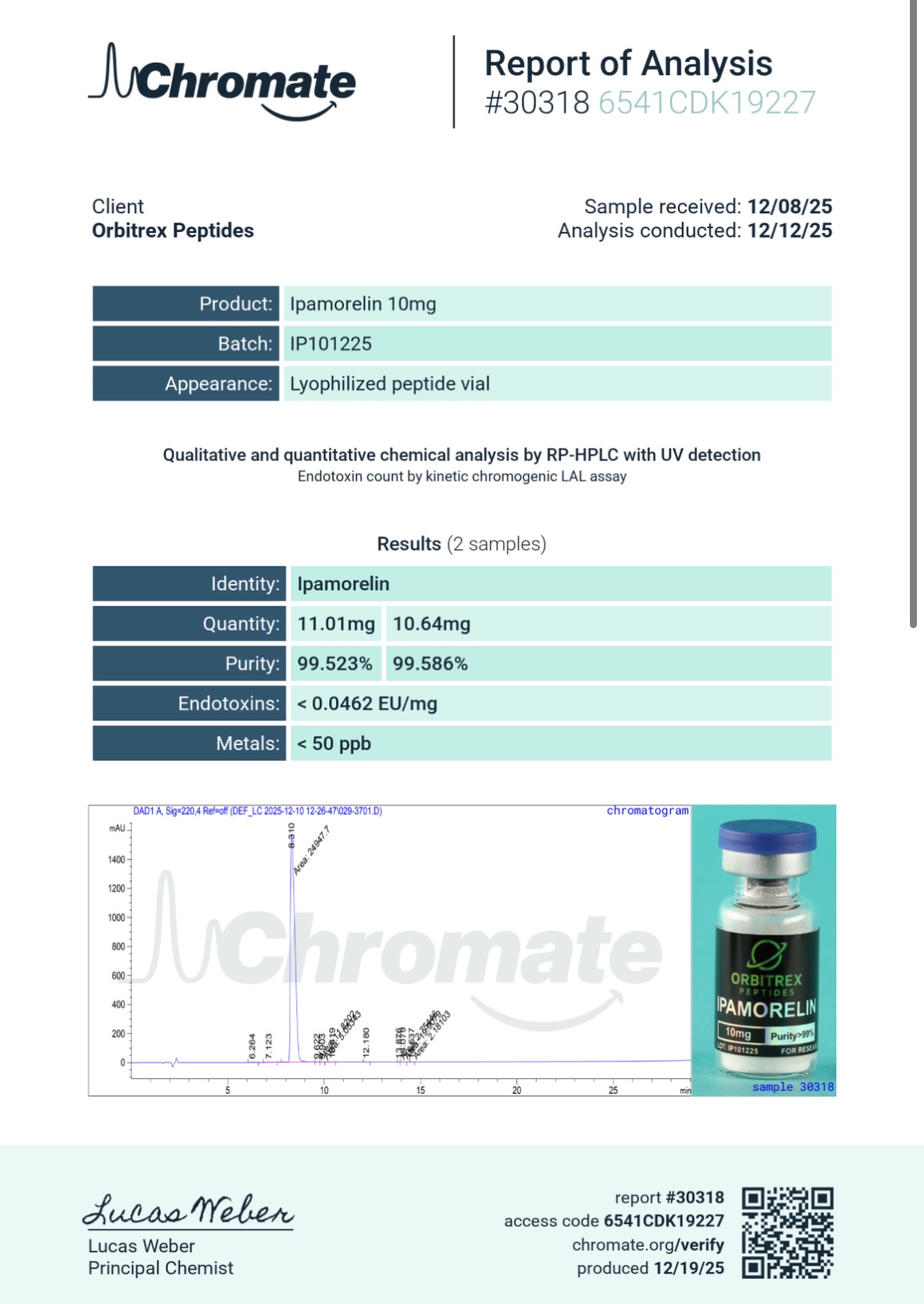
This is precisely why we guarantee that every single batch of our Ipamorelin 10mg Peptide undergoes the most rigorous, independent third-party testing available before it is ever cleared for distribution to the scientific community.
Our primary testing methodologies include High-Performance Liquid Chromatography (HPLC) and Liquid Chromatography-Mass Spectrometry (LC-MS). The HPLC analysis ensures that the molecular weight and retention time of the powder perfectly match the exact profile of pure, structurally stabilized pentapeptides, successfully separating out any potential biological contaminants, leftover manufacturing solvents, or truncated, biologically inactive peptide debris.
The Mass Spectrometry confirms the exact 5-amino-acid sequence of the peptide and specifically verifies the precise incorporation of the crucial Aib and D-isomer modifications. Manufacturing a pristine, enzymatically resistant pentapeptide requires immense biochemical precision; our LC-MS testing guarantees there are no missing, swapped, or malformed links anywhere within the intricate molecular structure.
We mandate strictly >99% purity for the Ipamorelin 10mg Peptide, ensuring your laboratory receives uncompromised materials entirely free from binders, heavy metals, synthetic impurities, or leftover manufacturing byproducts. When you source your complex endocrine materials from Orbitrex, you are sourcing absolute, verifiable reliability.
Preparation and Handling of the Ipamorelin 10mg Peptide
While ultra-short pentapeptides are remarkably sturdy compared to massive 40-chain hormones, the proper preparation, reconstitution, and storage of the Ipamorelin 10mg Peptide remain absolutely critical to maintaining its analytical efficacy and preventing rapid degradation prior to your planned cellular experiments.
The product is shipped as a lyophilized (freeze-dried) solid powder puck inside a sterile, vacuum-sealed glass vial. Lyophilization removes the water from the peptide solution under extremely low temperature and pressure, which stabilizes the fragile molecular bonds and allows the Ipamorelin 10mg Peptide to survive the domestic shipping process without rapid degradation, spontaneous aggregation, or structural collapse.
Reconstitution Protocols
To prepare the Ipamorelin 10mg Peptide for in-vitro application, the powder must be carefully reconstituted into a liquid solution. Because this is an industry-standard 10mg precision vial, researchers must carefully calculate the required volume of diluent to achieve their desired microgram-per-milliliter concentration (e.g., adding 2.0mL of diluent will yield a highly concentrated 5mg/mL solution, or 1.0mL for a dense 10mg/mL baseline yield). It is highly recommended to use sterile bacteriostatic water (water containing 0.9% benzyl alcohol) or sterile saline, depending entirely on the specific chemical requirements, osmolality, and pH sensitivities of your specific cell culture.
When introducing the diluent into the vial containing the Ipamorelin 10mg Peptide, standard sterile laboratory protocols must be strictly observed:
-
Swab the rubber stopper of both the peptide vial and the diluent vial with 70% isopropyl alcohol to ensure complete, uncompromised sterility.
-
Using a sterile syringe, draw the exact desired volume of diluent required for your specific baseline assays.
-
Inject the diluent extremely slowly into the peptide vial. Crucial: Direct the stream of the liquid against the inner glass wall of the vial rather than shooting it directly into the lyophilized powder puck. While the pentapeptide is structurally fortified, the force of a direct, high-pressure liquid stream can still physically shear the delicate peptide bonds of the Ipamorelin 10mg Peptide, irreparably damaging the molecules before they are ever utilized in your expensive cellular assays.
-
Do not shake the vial under any circumstances. Vigorous shaking will violently disrupt the structural stability of the entire molecule. Gently swirl or roll the vial between your fingers until the powder has completely dissolved into a perfectly clear, uniform solution.
Storage Guidelines for the Ipamorelin 10mg Peptide
Maintaining the molecular integrity of the Ipamorelin 10mg Peptide post-reconstitution is paramount to the success, accuracy, and reproducibility of your highly targeted research blocks.
Unreconstituted (Lyophilized Powder): If you are not utilizing the peptide immediately upon delivery, the dry powder should be stored away from direct sunlight in a completely dry, temperature-controlled environment. For short-term storage (up to 30 days), standard room temperature is acceptable, though refrigeration is always strongly preferred. For long-term storage (up to 24 months), the lyophilized vials must be kept in a dedicated laboratory freezer at -20°C.
Reconstituted (Liquid Solution): Once bacteriostatic water or saline has been introduced to the Ipamorelin 10mg Peptide, the structural degradation clock begins ticking immediately. Because this is a highly active sequence designed for precise baseline testing, storage protocols must be strict. The reconstituted vial must be immediately refrigerated at 2°C to 8°C (36°F to 46°F). Even when kept at precise, temperature-controlled refrigerated settings, the mixed solution must be utilized in your laboratory assays within 20 to 30 days. Beyond this tight window, the delicate 5-chain peptide will begin to naturally degrade, losing its biological potency, breaking down into unusable fragments, and inevitably skewing your vital analytical baseline data.
Disclaimer: All products listed by Orbitrex, including the Ipamorelin 10mg Peptide, are sold strictly for in-vitro laboratory research and analytical purposes only. They are not intended for human consumption, ingestion, diagnostic, therapeutic, or agricultural use. Our products are not FDA-approved for human use. Any communications implying human use, clinical trials on unapproved human subjects, or bodily injection will result in the immediate cancellation of your account and permanent restriction from our supply chain. All researchers must adhere to their local institutional review board (IRB) guidelines when handling these research materials.