Comprehensive Research Guide to Acetic Acid Solution: The Science of Laboratory Solvents and pH Regulation
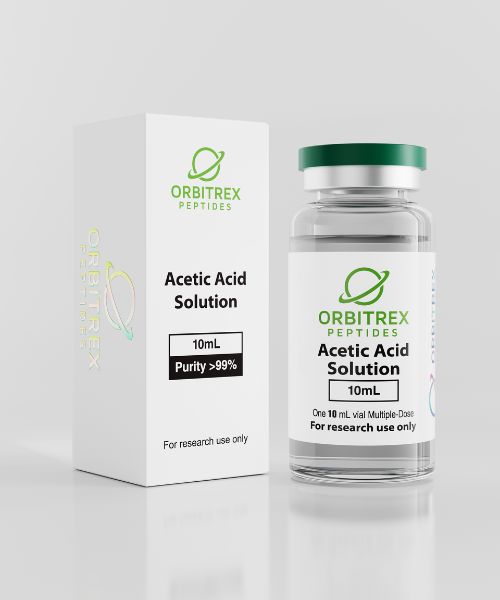
When exploring the absolute cutting edge of biochemical research, advanced histology, and precision peptide synthesis, few chemical reagents offer the profound, foundational importance of Acetic Acid Solution. Known scientifically as ethanoic acid ($CH_3COOH$), this simple carboxylic acid is far more than a common household ingredient. In a high-purity laboratory setting, it acts as a primary polar protic solvent, fundamentally dictating the solubility of complex proteins, the preservation of biological tissues, and the precise titration of chemical reactions.
This comprehensive guide delves deeply into the biochemical science, structural mechanisms, and rigorous laboratory applications of Acetic Acid Solution, providing scientific professionals, longevity researchers, and dedicated biohackers with the critical data required to fully understand its vast physical potential. Whether your focus is investigating the optimal reconstitution of hydrophobic peptides, studying the profound impact of acid-fixation on cellular morphology, or exploring novel pathways for antimicrobial surface sterilization, this specific high-purity formulation offers a highly reliable, heavily documented profile for rigorous scientific observation.
The Science of Solubility: Why Acetic Acid Solution is a Laboratory Essential
To fully grasp the massive efficacy of this critical reagent, it is essential to trace the biological challenges of peptide and protein handling. Many of the most potent research peptides—such as those used in metabolic and neurological studies—possess a “hydrophobic” (water-fearing) nature. When a researcher attempts to dissolve these compounds in standard bacteriostatic water or saline, they often encounter massive clumping or incomplete dissolution, which renders the resulting solution inaccurate for precise dosing.
Acetic Acid Solution acts as the absolute biological “bridge.” Its unique molecular structure allows it to interact with both polar and non-polar segments of a peptide chain. By lowering the pH of the environment, the acid provides a slight positive charge to the peptide molecules, causing them to repel one another and disperse evenly into the liquid. By utilizing this massive, high-purity solvent in a biological system, scientists aim to literally “unlock” the solubility of stubborn compounds, ensuring a perfectly clear, 100% bioavailable solution for rigorous laboratory testing.
Structural Science: The Chemistry of the Carboxyl Group
At its core, Acetic Acid Solution consists of a methyl group ($CH_3$) attached to a carboxyl group ($COOH$). This specific arrangement makes it a weak acid, meaning it does not fully dissociate in water, allowing for much finer control over pH levels than stronger mineral acids like hydrochloric acid.
In terms of functional biology, the Acetic Acid Solution works through the donation of protons ($H^+$ ions). This acidity is what allows it to act as a powerful preservative and fixing agent. In histology, the acid penetrates tissues rapidly, cross-linking proteins and “freezing” the cellular structure in place. This prevents the massive enzymatic degradation (autolysis) that would otherwise destroy a sample before it could be studied under a microscope. In modern research environments, the specific Acetic Acid Solution format is highly preferred because it provides an incredibly precise, clinically significant yield for targeted studies in protein crystallization and mass spectrometry.
Pharmacokinetics: Absorption, Tissue Penetration, and Metabolic Pathways
Understanding the complex pharmacokinetic profile of this vital organic acid is absolutely vital for properly structuring laboratory experiments, determining accurate concentrations, and understanding its systemic influence.
Rapid Penetration and Cellular Fixation
Acetic Acid Solution is characterized by its remarkably small molecular size and high volatility. When applied to biological samples or utilized in chemical synthesis, the acid exhibits incredibly rapid penetration. The unique molecular structure allows the Acetic Acid Solution to move through lipid membranes with ease. In histological research, this rapid penetration is what allows for the “fixing” of large tissue blocks, ensuring that the internal structures are preserved as perfectly as the surface layers.
Metabolic Clearance and Acetyl-CoA Integration
If trace amounts of Acetic Acid Solution enter a biological system (as is common when used as a peptide solvent), the body treats it as a natural metabolic intermediate. It is rapidly converted into Acetyl-CoA—the absolute foundational “fuel” for the Krebs cycle. Studies indicate that the biological clearance of acetate is typically measured in minutes, as the body’s cells rapidly oxidize it into carbon dioxide and water. This ensures that the solvent properties of the acid do not interfere with long-term metabolic observation in research models.
The Mechanism of Action: How Acetic Acid Solution Interacts with the Body
Understanding how this specific, targeted reagent exerts its profound solvent and antimicrobial effects requires a highly detailed dive into chemical thermodynamics. Its mechanism of action is distinctly multifaceted, operating seamlessly across several biological systems simultaneously to facilitate an optimized research environment.
1. Peptide Reconstitution and Charge Stabilization
The primary, absolutely critical mechanism observed in peptide research is the protonation of amino acid side chains. By flooding the environment with the Acetic Acid Solution, researchers can adjust the “isoelectric point” of a peptide. This leads to a massive increase in the electrostatic repulsion between individual peptide molecules. This mechanism provides a massive biological unlock for researchers studying IGF-1, GHRP, and other notoriously difficult-to-dissolve sequences, ensuring that no active material is lost to precipitation.
2. Histological Fixation and Protein Cross-Linking
Beyond solubility, this reagent heavily targets the structural integrity of biological samples. The Acetic Acid Solution is a primary component of “Bouin’s Fluid” and other famous fixatives. It works by denaturing proteins and precipitating nucleic acids, effectively “locking” the DNA and RNA into a stable matrix. This “structural shift” is exactly why the acid is aggressively studied for its massive potential to completely eliminate the artifacts and distortions that often plague delicate tissue staining and electron microscopy.
3. Antimicrobial Defense and pH Stress
The compound successfully targets the cell walls of common laboratory contaminants. By lowering the external pH, the Acetic Acid Solution creates a massive “proton gradient” that overwhelms the internal pumps of bacteria and fungi. This highly nuanced antimicrobial effect is exactly why the acid is a primary subject of interest for researchers looking to maintain sterile environments without the use of toxic heavy metals or complex antibiotics that might skew research data.
Primary Research Applications in the Laboratory
The remarkably diverse, absolutely foundational biological activities of this molecule have led to a rapidly expanding array of high-level research applications. The baseline Acetic Acid Solution formulation is particularly useful for exploring the following cutting-edge scientific avenues:
Reconstitution of Hydrophobic Peptides
In the realm of biochemistry, this solution is considered a groundbreaking tool for studying the solubility of complex amino acid chains. Studies frequently focus on its capacity to aggressively dissolve peptides that are otherwise insoluble in water. Researchers utilize the Acetic Acid Solution to observe how biochemical interventions can completely neutralize the “clumping” of active ingredients, ensuring that laboratory results are based on accurate, fully dissolved concentrations.
Advanced Histology and Cytology
Because of its unique, profound ability to supercharge the preservation of cellular detail, it acts as a profoundly powerful diagnostic catalyst. Experimental models show that utilizing the massive solution in fixative blends significantly improves the clarity of chromosomal staining and nuclear detail. Researchers deeply use the Acetic Acid Solution molecule to map how the literal biological architecture of a cell can be actively maintained and protected against environmental degradation.
Chemical Synthesis and Buffer Preparation
Scientific performance and reaction yields are entirely dictated by the precision of the chemical environment. Studies involving the Acetic Acid Solution have deeply explored its unique ability to rapidly “tune” the pH of a reaction. By massively protecting the stability of sensitive molecules through buffering, it is continuously investigated as a critical, highly successful tool for violently accelerating the synthesis of new compounds and physically repairing the micro-errors caused by inconsistent reaction conditions.
The Importance of High-Purity Synthesis in Laboratory Settings
In any rigorous, peer-reviewed scientific study or biohacking protocol, the sheer absolute quality of the primary reagent directly dictates the absolute validity of the final results. Utilizing an ultra-high-purity Acetic Acid Solution is entirely non-negotiable for serious clinical researchers and dedicated laboratory professionals.
Impurities in standard industrial-grade acid can heavily include heavy metals, trace organic contaminants, or water-borne pathogens. If a laboratory or individual inadvertently utilizes a compromised, low-grade batch of Acetic Acid Solution, these invisible impurities can trigger massive, uncontrolled chemical side-reactions, damage delicate histological samples, or heavily skew quantitative analytical data, rendering months of incredibly expensive research completely invalid.
High-grade research reagents must ideally boast an absolute purity of strictly >99.7% (often referred to as Glacial or ACS Reagent Grade), independently verified by rigorous analytical testing. This massive quality control guarantees that the chemical activity observed during testing is directly, undeniably attributable to the pure, unadulterated ethanoic acid molecule and absolutely nothing else.
Preparation, Dilution, and Storage Protocols
Meticulous, proper handling is profoundly, absolutely critical to maintaining the chemical stability of this organic acid. Because the product is securely delivered as a stable, highly concentrated liquid, researchers must strictly follow proper safety and storage protocols.
Standard Dilution Protocol
To adequately prepare the Acetic Acid Solution for peptide reconstitution or histological work, it is typically diluted to a 0.1% to 1.0% concentration.
-
Always add acid to water (never water to acid) to completely prevent the risk of splashing or exothermic reactions.
-
Utilize glass or high-density polyethylene (HDPE) containers for mixing, as the acid can degrade low-quality plastics over time.
-
Ensure the workspace is well-ventilated, as the concentrated vapors of the Acetic Acid Solution can be irritating to the respiratory system.
Long-Term Storage Guidelines
-
Concentrated Solution: Before dilution, the stable liquid can be safely stored at room temperature for several years without any significant degradation. For extensive long-term storage (spanning several years), Acetic Acid Solution should be strictly kept in a dark, cool chemical cabinet away from strong oxidizers and bases.
-
Environmental Sensitivity: While the molecule is robust, it is highly hygroscopic—meaning it will “suck” moisture out of the air if the cap is left off. Vials and bottles should be kept consistently in an airtight storage area to ensure maximum biological efficacy and complete, absolute purity over time.
Frequently Asked Questions About Laboratory Acetic Acid
Why is this used for dissolving IGF-1 or GHRP-6?
The highly potent Acetic Acid Solution provides an unparalleled, laboratory-grade baseline for overcoming the hydrophobic nature of these specific peptides. By creating a slightly acidic environment (typically a 0.6% solution), the acid forces the peptide molecules to carry a positive charge, preventing them from sticking to the side of the vial or to each other. This ensures that the researcher is working with a true solution rather than a suspended slurry.
Is the solution structurally stable during standard international transit?
Yes, in its professionally sealed liquid form, the molecule is remarkably chemically robust. The manufacturing process ensures that the Acetic Acid Solution remains stable even when exposed to varying ambient temperatures during standard shipping. While it is always best practice to immediately store the acid in a cool, well-ventilated environment upon arrival, standard transit times do not heavily compromise the strict integrity of the product.
Can it be used in conjunction with other research reagents?
In highly advanced, multi-variable study protocols, the Acetic Acid Solution is frequently and massively successfully researched alongside other solvents and fixatives, such as Formaldehyde (for massive tissue-fixing synergy) or Methanol (for absolute protein precipitation). Researchers closely monitor these specific, complex combinations to document massive potential synergistic effects on the preservation of biological structures and broader, absolute chemical optimization pathways.
Conclusion: The Absolute Future of Laboratory Precision
The ongoing, massive global exploration of organic solvents represents the absolute cutting edge of modern biology and severe chemical medicine, and the Acetic Acid Solution remains at the very forefront of this massive biochemical scientific revolution. From its profound, heavily documented ability to perfectly regulate pH and solubility to its incredible histological and antimicrobial capabilities, it offers clinical researchers a highly reliable, incredibly potent, and endlessly fascinating compound for biochemical study.
By ensuring your laboratory sources an ultra-high-purity product and adheres strictly to rigorous handling protocols, you can confidently explore the vast, absolutely untapped potential of this remarkable molecule. As advanced molecular research methodologies violently evolve and analytical mapping technology improves, the massive empirical data generated from Acetic Acid Solution studies will undoubtedly continue to heavily unlock profound new understandings of protein dynamics, absolute cellular preservation, and ultimate human longevity.
(Disclaimer: All information provided regarding this product is strictly for educational and informational purposes. This product is sold exclusively for laboratory and research use. It is not intended for human consumption, diagnosis, treatment, or cure of any disease or condition.)